Why Your Pool Turns Green After a Monsoon Storm
The call almost always comes on a Tuesday or a Wednesday. There was a storm over the weekend, the pool looked a bit cloudy on Sunday, and by Tuesday it’s green.
It reads like the storm turned the pool green, and in a sense it did, but not by putting algae in the water. Algae spores are already in your pool, all the time, in every pool in the Valley. What a monsoon storm does is remove the thing that was keeping them from growing.
What does a monsoon storm put in your pool?
Three things at once: organic debris that consumes chlorine as it breaks down, dust carrying phosphates and nitrates that algae feed on, and runoff carrying organic acids off the deck and yard. Each creates chlorine demand on its own. Together they can empty a pool of free chlorine within hours of the storm passing.
They compound, which is why the effect is bigger than any one of them suggests.
Organic debris. Leaves, blossoms, seed pods, insects, and whatever was sitting on the deck. All of it consumes chlorine as it breaks down.
Dust and dirt. A haboob deposits a fine silt layer across the surface and into the water. Beyond loading the filter, dust carries phosphates and nitrates, which are nutrients algae feed on.
Tannins and runoff. Water sheeting off the deck, the yard, and the surrounding landscape carries organic acids and whatever was on those surfaces into the pool.
Each of those creates chlorine demand. Together they can consume most of the free chlorine in a residential pool within hours of the storm passing. A pool holding a healthy 3 ppm on Saturday afternoon can be near zero by Saturday night.
How long do you have before the pool turns green?
Roughly 24 to 48 hours. Algae doesn’t bloom the moment chlorine hits zero; there’s a lag between the sanitizer being consumed and visible growth. Add chlorine inside that window and the pool goes back to where it was. Miss it and you’re fighting an established bloom that consumes chlorine faster than you can add it.
Here’s the part that decides whether this is a $40 problem or a $400 one.
Algae doesn’t appear the moment chlorine hits zero. There’s a lag, usually a day or two, between the sanitizer being consumed and visible growth. In that window, adding chlorine puts the pool back where it was and nothing further happens.
Miss the window and you’re no longer fighting spores. You’re fighting an established bloom that’s actively producing more of itself, coating surfaces, and consuming any chlorine you add faster than you can add it. That’s the difference between a shock treatment and a full recovery, which typically runs $300 to $600 and takes three to five days.
Arizona heat closes that window fast. Above 110°F with strong UV, algae reproduces quickly and the chlorine you add to stop it is degrading at the same time. It’s the same mechanism that makes a 14-day service interval fail here when it works fine elsewhere.
What to do in the first 24 hours
If a storm has just gone through and the pool is still clear or only slightly cloudy:
- Get the debris out. Skim the surface and empty the skimmer and pump baskets. Everything organic left in the water is consuming chlorine you’re about to pay for.
- Run the pump. Circulation is what gets sanitizer to the surfaces where algae starts. If you run a variable-speed pump on a schedule, override it and run it continuously until the water clears.
- Test, then dose. Test free chlorine before adding anything. If it’s at or near zero, the pool needs chlorine now. Dosing blind is what causes the second problem below.
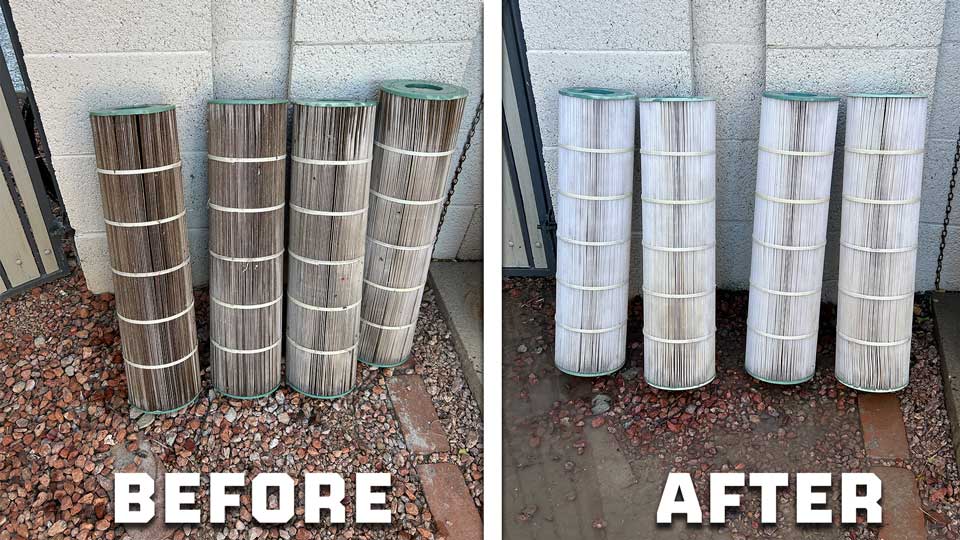
- Check the filter pressure. Storm debris loads a filter fast, and a restricted filter means poor circulation exactly when circulation is what you need. Our guide to reading the pressure gauge covers what the number should be.
Why does shocking the pool sometimes make it worse?
Because most tablet and granular chlorine is stabilized, meaning it carries cyanuric acid with it. Stabilizer doesn’t evaporate and doesn’t break down. Shock aggressively a few times over a summer and it accumulates until it starts locking chlorine up rather than protecting it, and the only real fix is replacing water.
The instinct after a storm is to dump in a lot of chlorine. That instinct is right. The product choice often isn’t.
Most chlorine sold in tablet and granular form is stabilized, meaning it contains cyanuric acid. Stabilizer is genuinely useful in Arizona, because it’s what stops UV destroying chlorine within a day. But it doesn’t evaporate and it doesn’t break down meaningfully. It only leaves when water leaves.
Shock the pool aggressively with stabilized product a few times over a summer and cyanuric acid climbs. Past a certain point it starts locking chlorine up rather than protecting it: the test kit says you have chlorine, and the chlorine does nothing. At that stage the only real fix is partially draining and refilling, which in a desert is neither cheap nor something anyone enjoys doing.
If you’re shocking, use an unstabilized product. If you’ve shocked several times this season and the pool still won’t hold chlorine, test cyanuric acid before adding anything else.
When it’s already green
Once the pool is green, the sequence matters more than the chemicals do. Test first. Adjust pH so the chlorine you add will actually work. Shock in sustained doses rather than one big one. Brush every surface so the algae is exposed rather than sheltered. Run filtration continuously, and clean the filter repeatedly as it loads with dead algae.
Skipping the brushing is the most common reason a DIY recovery stalls at “less green” and stays there. Stopping filtration overnight is a close second.
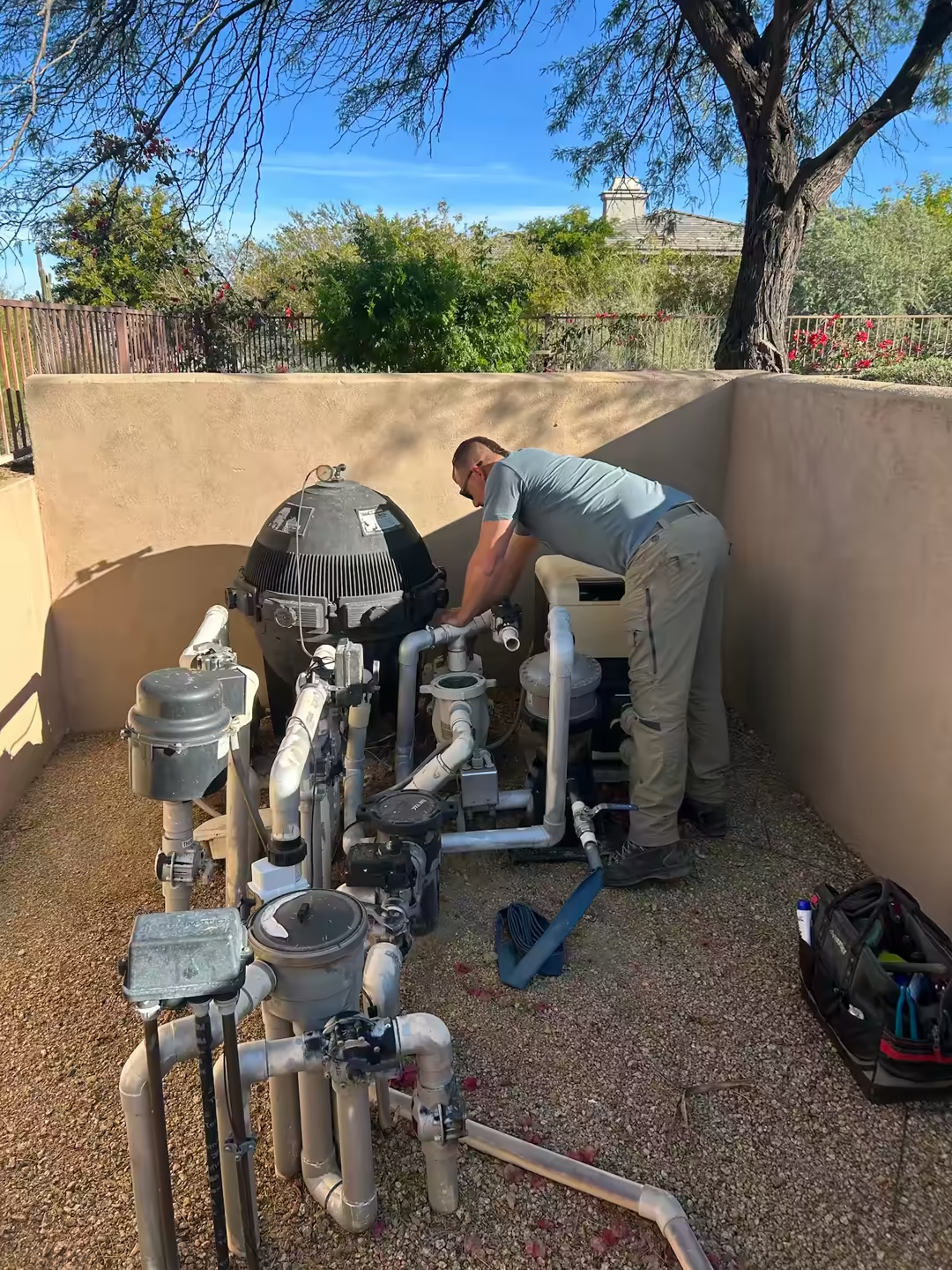
We run these regularly, and the honest answer is that the pool being green is rarely the actual problem. It’s the visible symptom of something else: a pump that isn’t moving enough water, a filter that hasn’t been cleaned in a year, stabilizer that climbed past the point of usefulness, or a service interval that doesn’t match the climate. If we clear the water and none of that changes, you’ll be looking at the same pool again after the next storm. Sometimes the fix is chemistry, and sometimes it’s equipment repair.
That’s why most of our recovery customers end up on weekly service afterwards, and why most of them don’t see a green pool again.
If yours has turned and you’d rather not spend the week on it, call (623) 388-7069. We cover Scottsdale, Cave Creek, and Carefree. We’ll look at it, tell you what’s actually driving it, and give you a written quote before any work starts.
Common Questions
Most recoveries run three to five days from the first visit to swim-ready water. The timeline depends on how far the algae got, how long the pool sat, and whether the filtration equipment is actually working. Heavily contaminated pools with poor circulation can take up to seven days.
If chlorine is low and the pool is still clear, adding chlorine promptly is the right instinct and it's far cheaper than a recovery. What tends to go wrong is dosing blind. Adding a large amount of stabilized chlorine drives cyanuric acid up, and once stabilizer is too high the chlorine you add stops working, which is a problem you can't fix without draining water.
No. During recovery the water holds very high concentrations of chlorine and treatment chemicals that aren't safe to swim in. We confirm with a final water test once the water has cleared and chemistry has stabilized, usually around day four or five.
Recovery typically runs $300 to $600 depending on pool size, how severe the algae is, and how many visits it takes. All chemicals used during the recovery are included, and we quote before any work begins so there are no surprise add-ons.
Want us to handle it?
Free assessment, no diagnostic fee, no obligation. We serve Scottsdale, Cave Creek, and Carefree.