How to Read Your Pool Filter Pressure Gauge
Every pool filter has a pressure gauge on it, and on most pools nobody has looked at it in years. It’s the most useful piece of diagnostic equipment on your equipment pad, it costs about twenty dollars to replace, and it’ll tell you about a developing problem weeks before the water does.
Here’s how to actually use it.
How do you find your filter’s clean baseline?
Read the gauge immediately after a clean, with the pump at full speed and a few minutes of run time behind it. Whatever it shows is your baseline. Every reading from then on only means something measured against that number, which is why a gauge with no baseline behind it tells you almost nothing.
A reading on its own really is meaningless. Fifteen PSI is fine on one system and a warning on another, and the difference is entirely down to filter size, plumbing and pump speed. So get the number first, before you try to interpret anything.
Clean it properly before you read it: cartridges pulled and hosed, sand backwashed, or DE backwashed and recharged.
Write it on the filter housing with a paint pen. Not on your phone, not in a note you’ll lose. On the filter, where the next person to look at it will see it.
Most residential systems land somewhere between 8 and 20 PSI clean, depending on filter size, plumbing, and pump speed. If you have a variable-speed pump, take the reading at the speed you actually run most of the time and note the speed next to it, because the number changes with RPM.
At what PSI should you clean the filter?
Clean it once the gauge sits 8 to 10 PSI above your clean baseline, and treat anything approaching 30 PSI as a stop-now problem rather than a scheduling one. Those are the only two numbers worth watching, and both are relative to your own baseline rather than to any figure printed on the filter.
Baseline plus 8 to 10 PSI: time to clean. As the filter media traps debris, water has a harder time getting through it, and pressure on the gauge climbs. Once you’re 8 to 10 PSI above clean, the media is loaded enough that flow through the system is meaningfully reduced. This is the point to clean, not the point to start thinking about it.
Approaching 30 PSI: stop and deal with it. At this end of the range you’re no longer just losing efficiency. The pump is straining against a restriction and running hotter than it was built to. Circulation across the pool has dropped far enough that dead spots start growing algae even with chlorine in range. Heaters have a minimum flow requirement and will refuse to fire, or will short-cycle, when the filter is this restricted.
In Arizona’s dust, most filters get there every four to six weeks during heavy use. Palo verdes and mesquites shorten that considerably, especially through the spring blossom drop.
What is a rising or falling gauge telling you?
Rising pressure means the filter is loading with debris, which is normal and expected. Falling pressure means less water is reaching the filter at all, which is a restriction somewhere upstream and usually the more urgent of the two. A needle that bounces is air in the system. Here is each case in turn.
Pressure climbing steadily over weeks. Normal. That’s the filter doing its job. Clean it at the threshold.
Pressure climbing fast, in days rather than weeks. Something is loading the filter far quicker than debris alone. Dead algae after a treatment will do it, which is why pressure spikes during a green pool recovery and needs watching through the whole process. A broken-down DE grid or a torn cartridge letting media migrate will do it too. If the pool has been cloudy, expect this and expect it to settle after a clean or two.
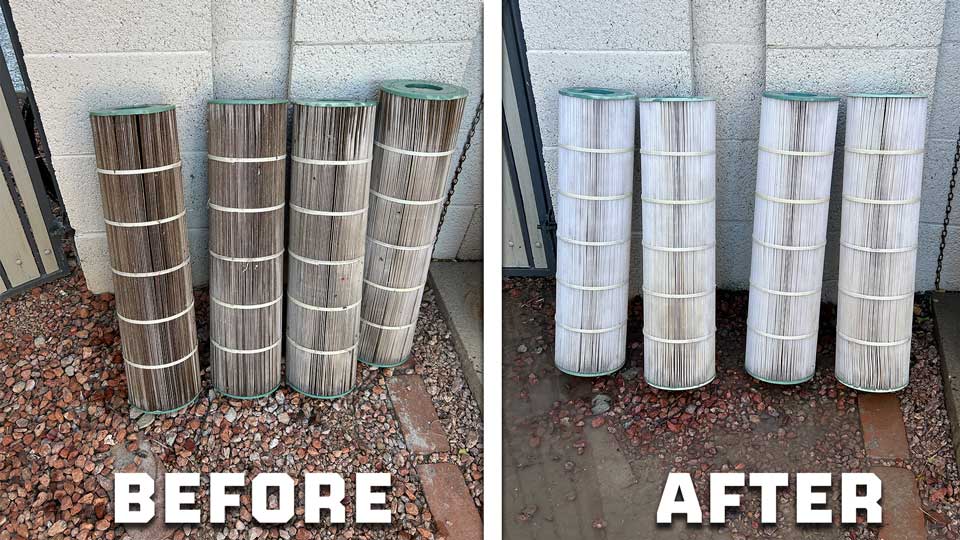
Pressure high and staying high right after a clean. The media isn’t actually clean. Cartridges hold oils and sunscreen that a garden hose won’t remove, so they need a chemical soak, and eventually they need replacing. Sand channels and clumps over time and stops filtering evenly, which is why sand typically gets replaced every five to seven years. On a DE filter it usually means the grids need attention. Any of these can turn into a filter repair or replacement rather than a clean.
Pressure below baseline. This is the one people misread as good news. Low pressure means less water is arriving at the filter, which is almost always a restriction upstream: a full skimmer basket, a full pump basket, a suction-side air leak, a valve someone half-closed, or a water level low enough that the skimmer is pulling air. Check the pump basket first. It’s free, and it’s the answer most of the time.
Needle bouncing or jittering. Usually air in the system, which points at a suction-side leak. Check the pump lid o-ring and that the lid is seated properly before assuming anything worse.
Gauge reading zero with the pump running. Either the pump isn’t moving water, so check whether it has lost prime, or the gauge itself has failed. Gauges fail often, and they fail stuck. If the reading hasn’t moved at all in months, it’s probably the gauge, and replacing it is a twenty-dollar job.
What else does a restricted filter affect?
Three things beyond the filter itself: the pump motor runs hotter and loses bearing and seal life, the heater may refuse to fire because flow drops below its safety switch, and circulation falls far enough that the far end of the pool gets less sanitizer than your test kit suggests. All three show up later as problems that look unrelated.
It’s worth being specific about why the 30 PSI line matters, because “bad for your equipment” is the kind of vague warning that’s easy to ignore.
A restricted filter reduces flow through every part of the loop. Your pump motor is designed to move a certain volume against a certain resistance, and when the resistance climbs the motor works harder, draws more current, and runs hotter. Heat is what kills motor bearings and shaft seals, so months of running against a loaded filter shows up later as a pump repair that looks unrelated.
Heaters care even more. Gas heaters and heat pumps both have a flow switch that prevents firing when water isn’t moving fast enough through the exchanger, because firing without flow would damage it. A filter at 28 PSI can drop flow below that switch’s threshold, and the symptom you see is a heater that won’t start or starts and quits, which sends people looking for a heater fault that isn’t there.
And circulation is what distributes sanitizer. Reduced flow means the far end of the pool, the steps, and anywhere behind a ladder get less chlorine than the test kit at the skimmer suggests. That’s how a pool with a perfectly normal chlorine reading still grows algae in the corners.
Why we check it at every visit
Filter pressure is a leading indicator. It changes before the water clouds, before the heater throws a code, and long before a pump motor fails. A pressure check takes about five seconds, which is why it’s part of every weekly service visit and why the reading goes on the service report we leave behind.
Most of what it flags is routine. The filter needs a clean, the baskets need emptying. Occasionally it catches something worth catching early: a failing impeller, a suction leak pulling air into the system, a heat exchanger starting to scale. Those are cheap problems in July and expensive ones in September.
If your gauge is reading something you can’t explain, or you don’t know what its baseline should be, give us a call at (623) 388-7069. We serve Scottsdale, Cave Creek, and Carefree, and we’ll read the whole system rather than guessing from one number, then tell you what it needs before any work starts.
Common Questions
There's no universal number. The right pressure for your filter is whatever it reads immediately after a clean with the pump at full speed, which is usually somewhere between 8 and 20 PSI depending on the system. That reading is your clean baseline, and everything after that is measured against it. A clean is due once you're 8 to 10 PSI above it, or approaching 30 PSI.
Yes. A clogged filter means the pump is working against a restriction, which reduces flow through the whole system and makes the motor run hotter than it was designed to. Sustained high pressure shortens motor and seal life, starves the heater of the flow it needs to fire, and reduces skimming and circulation, which is how algae gets its foothold.
Low pressure usually means less water is reaching the filter, not that the filter is unusually clean. The common causes are a clogged skimmer or pump basket, a suction-side air leak, a closed or partly closed valve, a low water level letting the skimmer draw air, or an impeller packed with debris. A pump that's losing prime will show low pressure too.
In our dust, most filters reach the cleaning threshold every four to six weeks during heavy use. Pools under palo verdes or mesquites get there faster because of the blossom drop in spring. Rather than working to a calendar, watch the gauge and clean when it reads 8 to 10 PSI above your clean baseline.
Want us to handle it?
Free assessment, no diagnostic fee, no obligation. We serve Scottsdale, Cave Creek, and Carefree.