Weekly vs Biweekly Pool Service in Arizona

If you moved to the Valley from somewhere with actual seasons, biweekly pool service probably sounds reasonable. In most of the country it is. Chlorine holds, algae grows slowly, and a pool can sit two weeks between visits without anything going wrong.
Arizona is a different problem, and the reason isn’t that our pools are dirtier. It’s that the two things keeping a pool clear, free chlorine and the stabilizer that protects it, both burn off here faster than they do anywhere else in the country.
What a 14-day gap actually looks like
Free chlorine gets consumed by two things: contaminants in the water, and ultraviolet light. In a Phoenix-area summer, with surface temperatures regularly above 110°F and UV near the top of the national range, the UV half of that equation dominates. Chlorine added on a Monday can be effectively gone by Wednesday.
Cyanuric acid, usually called stabilizer, is what slows that down. It binds to chlorine and shields it from UV, which is why it’s in almost every Arizona pool. But stabilizer degrades too, and it degrades faster under the same conditions eating the chlorine. So the protection thins out over the summer at exactly the point you need it most.
Put those together across two weeks and you get a predictable sequence:
- Days 1 to 3. Chlorine is in range. The pool looks fine.
- Days 4 to 7. Free chlorine drops below the level that suppresses algae. Nothing is visible yet. Algae spores are always in the water, and they’re now unopposed.
- Days 8 to 11. Growth starts on the surfaces with the least circulation: steps, behind the ladder, the shaded end. Water starts to look dull rather than green.
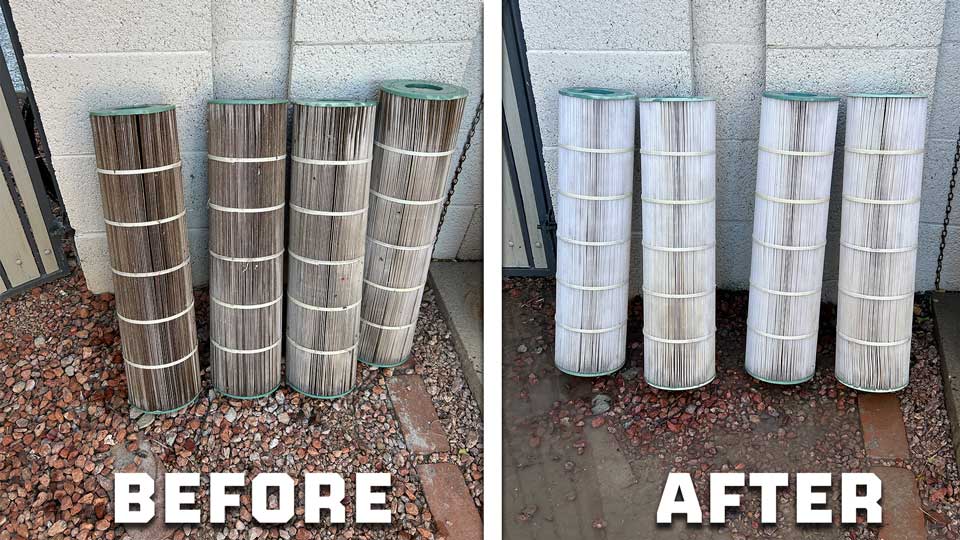
- Days 12 to 14. Visible bloom, or a pool that clears up on the next visit but has left a stain line and a filter full of dead algae.
That last outcome is the one most people underestimate. A pool that goes green and comes back isn’t free. Somebody paid for shock, a filter clean, and often a stain treatment.
How does monsoon season change the maths?
A storm can strip most of the free chlorine from a pool in a matter of hours, and it lands wherever it lands in your service cycle. On a weekly route that gap is at most seven days. On a fourteen-day cycle the same storm can hit on day two and leave the pool unsanitized for nearly two weeks in the hottest part of the year.
From July through September, monsoon storms drop organic debris, dust, and tannins into open pools overnight. A single storm can consume most of the free chlorine in a pool within hours, and it doesn’t check the service calendar first.
On a weekly route, a storm lands somewhere in a seven-day window and the pool is back in range within days. On a biweekly route, that same storm can land on day two of a fourteen-day gap, and the pool spends nearly two weeks with no effective sanitizer during the hottest part of the year. That’s how most of the green pool recoveries we run actually start, and it’s covered in more detail in our piece on why pools turn green after a monsoon storm.
Does hard water damage pool equipment?
Yes, and it does it quietly. Valley water arrives high in calcium, summer evaporation concentrates it, and if pH and hardness aren’t adjusted regularly that calcium deposits on the heat exchanger inside your heater, on salt cell plates, and along the plaster waterline. Nothing looks wrong until a component stops working.
The other reason we push weekly isn’t about algae at all.
Most municipal water in the Valley comes through the Central Arizona Project, and it arrives high in calcium and total dissolved solids. Evaporation in summer concentrates it further, because the water leaves and the minerals stay. If pH and calcium hardness aren’t adjusted regularly, that calcium comes out of solution onto the things you least want it on: the heat exchanger inside your heater, the plates of a salt cell, and the plaster at the waterline.
This one doesn’t announce itself. There’s no green pool to tell you it’s happening. You find out when the heater starts short-cycling, when the salt cell stops producing, or when the tile line turns white and needs a bead blast. Scale removal means acid washing or replacing components, and by then you’re looking at equipment repair rather than maintenance. Scale prevention just means somebody checking calcium and pH on a schedule.
Two weeks of drift, twenty-six times a year, is enough to matter.
When is biweekly pool service actually enough?
When the pool is screened or covered, sits in shade for a good part of the day, has no heater or salt cell to protect from scale, and you’re willing to test and adjust chemistry yourself between visits. Winter helps too: from roughly November to March, chlorine demand drops enough that many Valley pools hold fine on a longer cycle.
We’re not going to pretend the answer is always weekly.
Biweekly can work if the pool is screened or covered, if it sits in shade for a good part of the day, if it has no heater or salt cell to protect, and if you’re willing to test and adjust chemistry yourself between visits. Winter is also a legitimately different season here. From about November to March, chlorine demand drops enough that many pools hold fine on a longer cycle.
What doesn’t work is biweekly service on an open, unshaded, heated pool in July, and then being surprised in August.
What we do instead
Our weekly pool service starts at $100 a month for a chemicals-only plan, and every visit includes a real reagent test rather than a dipped strip. We read pH, total alkalinity, calcium hardness, free chlorine, cyanuric acid, and total dissolved solids. Strips drift fast in the heat and they don’t read stabilizer accurately, and stabilizer is the one number that predicts how the next seven days will go.
The same technician runs the same route each week, which matters more than it sounds like it should. Knowing that your pump has always whined a little on startup, versus noticing that it started last Tuesday, is the difference between a seal replacement and a full pump repair.
If you’re on a biweekly plan and the pool has gone cloudy on you more than once this summer, that’s the schedule telling you something. We run routes across Scottsdale, Cave Creek, and Carefree. Get in touch and we’ll look at it and give you a straight quote, with no diagnostic fee and no obligation.
Common Questions
Often, yes. Between roughly November and March, water temperatures drop far enough that chlorine demand falls and algae growth slows, and a lot of pools hold their chemistry fine on a 14-day cycle. The problem is that switching back and forth means someone has to remember to switch back in April, and April is when the margin disappears. Most of our clients stay weekly year-round for that reason.
It depends on where your chemistry was when the technician left. A pool sitting at the top of its chlorine range with healthy stabilizer will usually survive one skipped week looking cloudy. A pool that was already at the bottom of the range can go visibly green in that time, because free chlorine in Arizona summer sun can be gone inside 24 to 48 hours.
No. A salt chlorine generator makes chlorine. It does not manage pH, alkalinity, calcium hardness, or stabilizer, and it does not brush walls or empty baskets. Salt pools also push pH up steadily as a side effect of how the cell works, so they need acid on a schedule. The visits are the same. The chlorine part is just automated.
Compare it against what it prevents. A green pool recovery runs $300 to $600 and takes three to five days, and a pump or heater that fails from months of poor circulation costs considerably more than that. Weekly service starts at $100 a month for a chemicals-only plan, so a single avoided recovery covers a good part of the year's difference.
Want us to handle it?
Free assessment, no diagnostic fee, no obligation. We serve Scottsdale, Cave Creek, and Carefree.